Social inference
A childhood game we all know and have played numerous times on the playground: Rock-Paper-Scissors (or Rock-Paper-Scissors-Lizard-Spock for the nerds among us). It requires us to think always one step ahead from our opponent to actually win the round. We do this by mentalizing (I think the other person thinks that,..), and this is an important skill to have. Mentalizing is how we anticipate social interactions, and when it goes wrong, we end up in situations where you reach out your hand for a handshake, and the other person goes in for three kisses on the cheek, so awkward hug it is.
Niklas Bürgi and colleagues designed a behavioral model to adaptively identify different levels of mentalization using a RPS game: the CHASE model (Bürgi et al., 2026). Prior experiments in the lab have shown that high-functioning adults with ASD are less sensitive to changes in the way others reason, and that the neural signature of adaptive mentalization is decreased. Now I will use this paradigm in adolescents with ASD, and relate it to multisensory salience processing to determine if performance in either domain relates to symptomology across the spectrum.
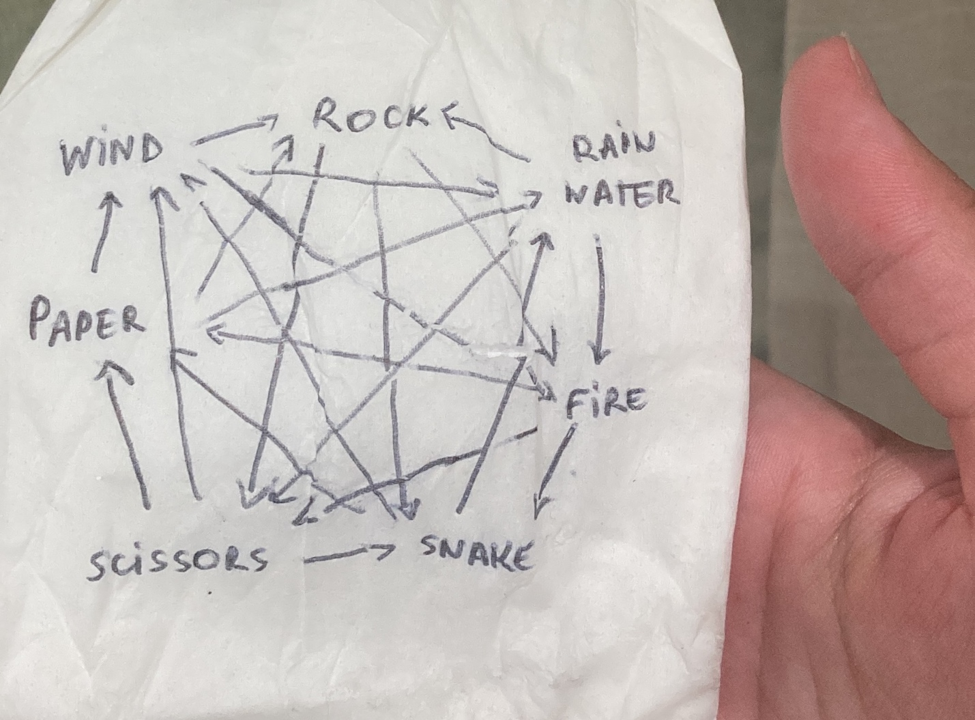
Some inspiration for an extended game of Rock-Paper-Scissors with thanks to Ahmed Ayman and the Sicilian sun:
Rock crushes scissors, scissors cut paper, paper wraps rock, rock kills snake, snake swims in water, water rusts scissors, scissors fly away in the wind, wind blows out a fire, fire burns snake, snake is taken by the wind, wind erodes rock, rock stops fire, fire burns paper, paper floats on water, water extinguishes fire, fire melts scissors, scissors cut snake, snake poisons paper, paper flies in wind, wind blows away raincloud’s water, and obviously water shapes rock.