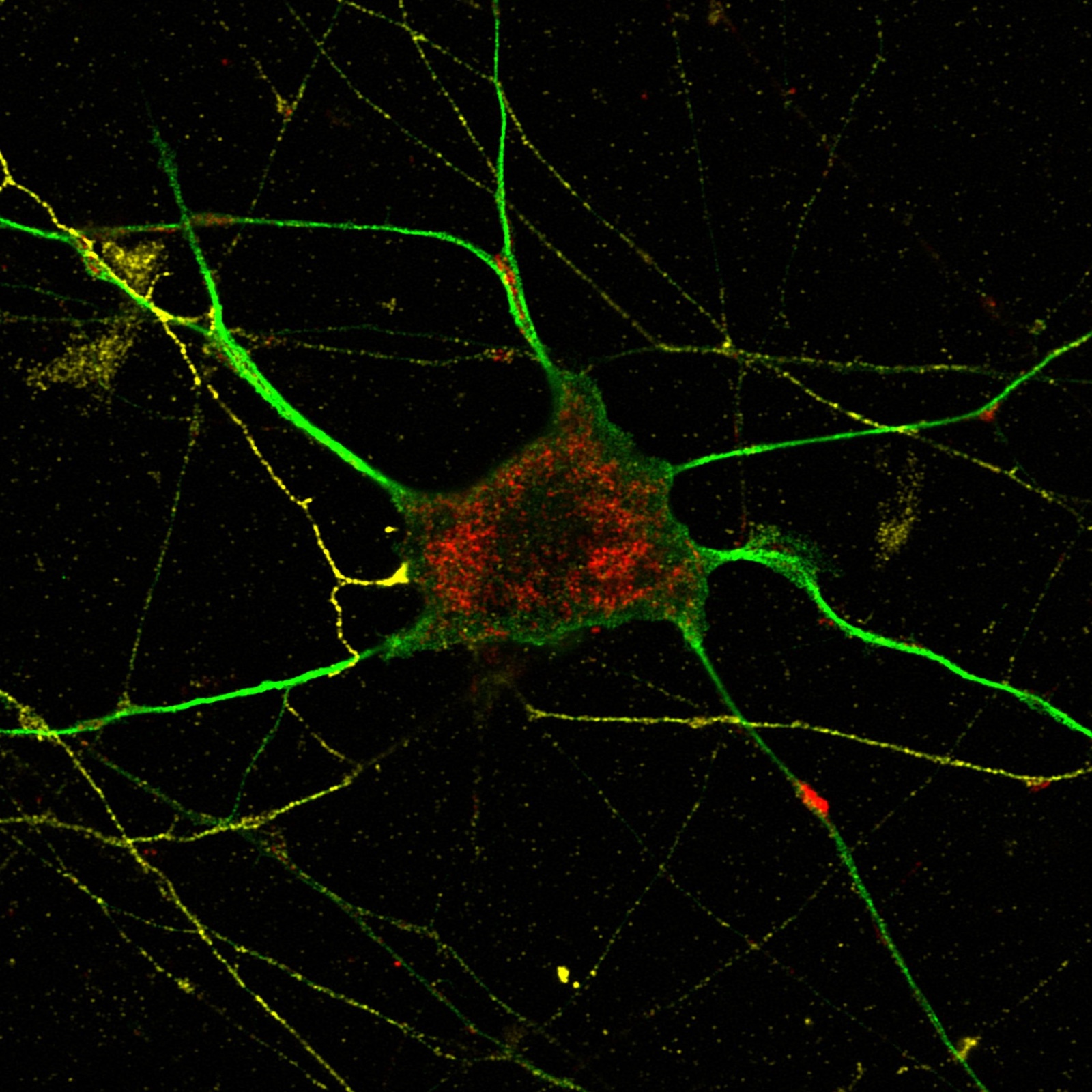
Neuronal organellar dynamics
A neuron has a busy schedule, it is almost like an alien city with different structures having specific roles leading to a well-oiled machinery that allows the necessary electrical signals to pass through and be processed. One of these structures is a lysosome. You can see it as a highly dynamic recycling site. But it does more than that, it also plays an important role in sensing how many nutrients the cell needs, or respond to cell damage. Depending on what the ‘alien city’ needs in that moment, it will adapt its workings.
Another interesting structure is the mitochondrion, the powerhouse. When a mitochondrion is not working properly, a cool thing they can do is fuse together with other mitochondria or degrade into smaller mitochondria. We call this fusion and fission, and this is strictly controlled through quality control. In an ideal ‘alien city’ we therefore have a branched network of powerlines throughout.
Now these different structures need to communicate with each other to switch out materials and information, they do this by giving ‘a little kiss’ in specific locations, we call these membrane contact sites. During my master’s thesis, I used images and videos of live neurons and zoomed in on these contact sites, and the structure and dynamics of the mitochondrial network in neurons with specific mutations that lead to Lewy Body Disorders.
Master's thesis, VIB-KU Leuven Center for Brain & Disease Research, with Prof. Wim Annaert.